The Monday Morning Mention – Part 2

For those of you who read my Monday Morning Mention post a few weeks ago , praising the efforts of the Welsh brass bands who became National Champions, I’m going to risk sounding repetitive now, I’m going to risk sounding repetitive now – sorry! – and reiterate my sentiments, but with one slight, but significant amendment.

Whilst the focus of discussion at the photo-copier this morning, will undoubtedly be on the Welsh rugby team’s inability to see off 13-man Australia in the Rugby World Cup and the wonderful achievement of the national football team in making its first major championships in over 50 years, I will champion the cause of our wonderful brass once again and highlight the fact that Wales also starts the week with not three, but FOUR National Champions now.

Congratulations to the Cory Band who, under the baton of their conductor Philip Harper, have once again won the National title at the Royal Albert Hall, performing Thomas Doss’s fiendishly difficult work “Spiriti”.

Cory_Smallish

Having been privileged to have performed on the Contest platform as a guest player with the Band earlier this year, I have had an insight into the effort that it takes to perform at the highest level and believe me, it borders on being scary! During that intense period of rehearsals, my Wife said to me “This brass band lark is a bit obsessive, isn’t it?” Perhaps there was more than an ounce of truth in that statement, but it goes to show how much effort and commitment went in to trying to win that competition!

It would be remiss also not to acknowledge the achievements of another Welsh outfit and my former Band – Tredegar Town Band – who came 5th at the same competition. A great day for Welsh brass bands indeed.

003

(Tredegar Town Band at the Royal Albert Hall, London in the 1990’s.)

So, yet another big shout out this Monday morning for the unsung heroes of Usk, Ebbw Valley, Goodwick and now Cory, who are now National Brass Champions of Great Britain, in Sections 4, 2 ,1 and Championship Sections respectively.

Rugby? What rugby match?

IMG_1240

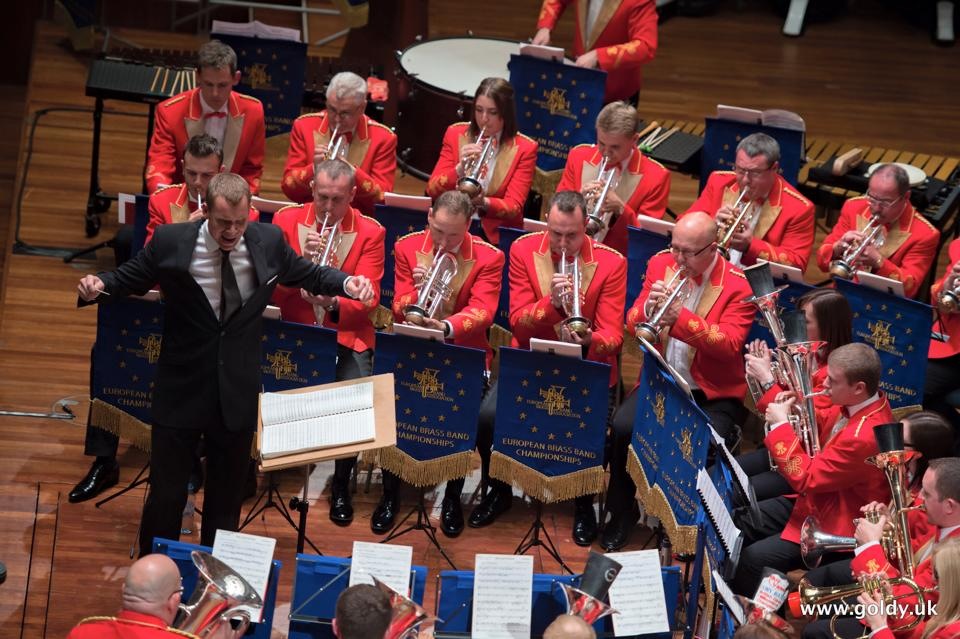
(The Cory Band performing at the 2015 European Brass Band Championships in Freiburg, Germany.)

Dispelling myths and preconceptions

On Sunday 4th October, Music for You made its début as an exhibitor in the world of Wedding Fayres.

The venue was the lovely Miskin Manor Hotel, near Llantrisant (which is on my door-step as it happens), however getting to the point where I was ready to bite the bullet and “go public” as an exhibitor had taken an extremely long time. The main worry was that I didn’t have snazzy enough marketing materials, glitzy banners and corporate wear and all the things that makes a self-employed sole-trader feel small and inadequate amongst all the established “bit-hitters” in the wedding industry.

My fears thankfully were unfounded, as all my fellow exhibitors were very helpful and generous with their compliments and advice, with lots of top tips to take away for future events – yes, to paraphrase Arnie “I’ll be back!” For a first time out, I felt I managed to “keep up with the Joneses” and the feedback was extremely positive, both from the exhibitors and visitors to the Fayre.

Once I had finally set up the stand, it was then down to the serious business of engaging, pardon the pun, with future brides, grooms and extremely worried looking parents (seeing their savings being rapidly blown by their daughters!) to try to persuade them of the merits of live music for their Wedding celebrations.

My main focus, was to try to promote the brass quintet, as this has so much versatility on a number of levels, particularly the musical repertoire it can offer. The quintet comprises two Trumpets, a French Horn, a Trombone and Tuba. What struck me instantly, was that the people I spoke to instantly assumed that brass instruments were either loud, brash, “in your face” and rather uncouth for a wedding and that the “noise” would be rather unrefined to say the least.

Thankfully, I was able to persuade all of the doubters to invest 30 seconds of their time and listen to some You Tube samples, notably Pachelbel’s Kanon performed by the quintet. My reward? My reward was the look of total delight and surprise on the faces of the future brides, quickly followed by “Mum, listen to this – it’s beautiful!”

So, the as the old saying goes “Don’t knock it, until you’ve tried it” rings true and I hope that my maiden voyage at  a wedding fayre, will produce some new “converts”, who at some point in the near future will actually book us for their very special day! Even if they don’t, they will now be aware of the wide range of colours and timbres that brass instruments can produce.

For more details about Music for You and our wedding music, please visit our web-site.

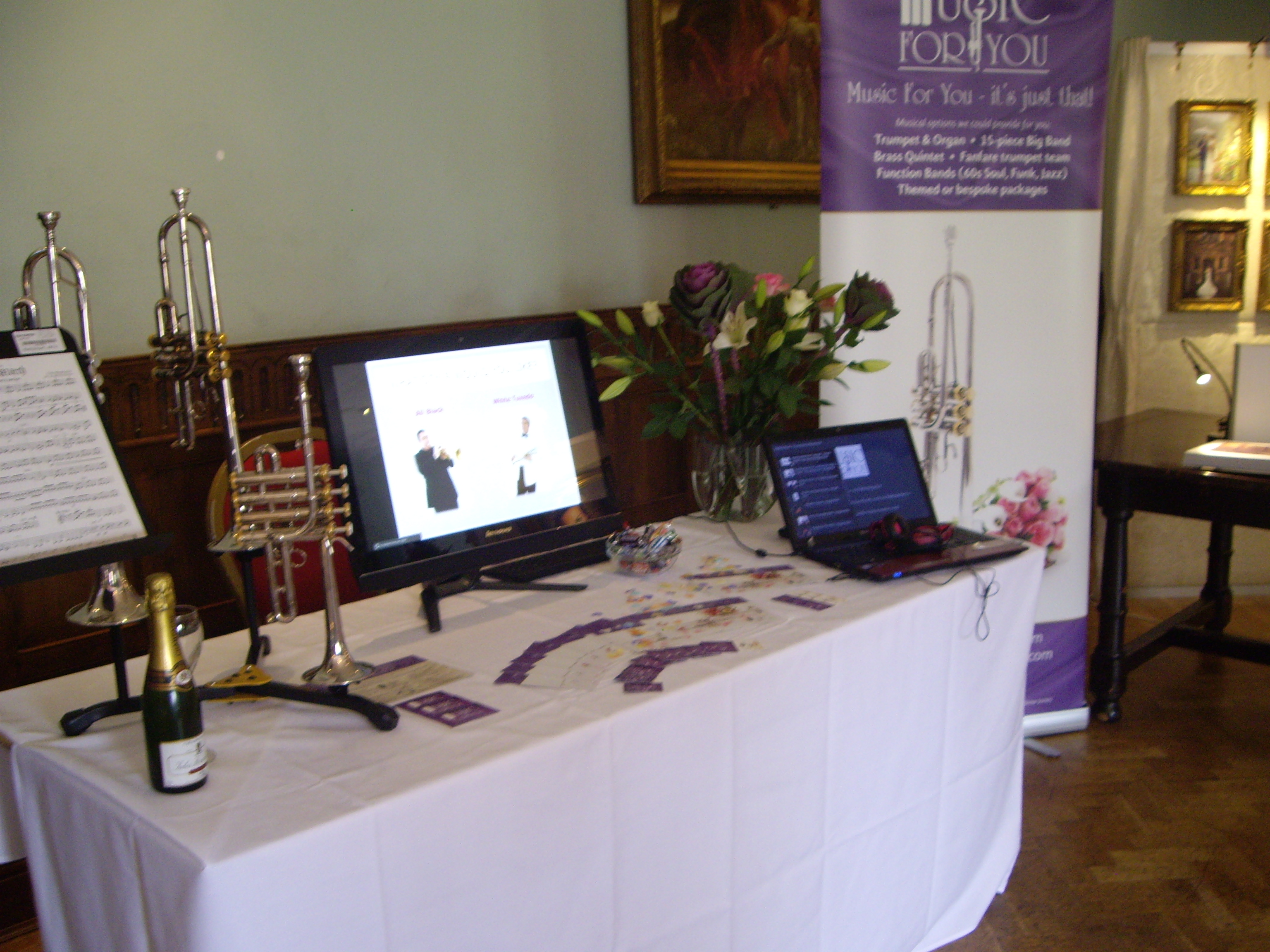
The Music for You Wedding Fayre stand

The Music for You Wedding Fayre stand

The Monday morning mention

The Welsh Nation will start another working week and the hot topic around the water cooler and by the photo-copier, will be the win against Uruguay and the massive upset caused by Japan against the South Africans in the Rugby World Cup.
Whilst on a totally different “playing field” – sorry couldn’t resist that – Wales also starts the week with THREE, yes 3 National Champions , from the world of brass bands.
Big deal huh? Yes, it was a massive deal, as each band had to qualify from it’s respective Region in the UK (typically a field of 10+ competitors) and then beat around 18/19 other bands in the Finals.

The amount of personal preparation, hours of endless practice and self-sacrifice, including financial, might not be on an exact par with the rugby players -it’s certainly a lot safer, that’s for sure! – but the achievement is just as hard-earned and means the world to those involved. This is all the more remarkable, given the standards of performance achieved and the fact that brass banding is an amateur pastime.

So, a big shout out this Monday morning for the unsung heroes of Usk, Ebbw Valley and Goodwick who are now National Brass Champions of Great Britain, in Sections 4, 2 and 1 respectively. This was their Rugby World Cup and if you’re from their area, tell everyone at the water cooler and by the photo-copier, because you’ll have something extra to smile about this morning!

For those of you interested in reading more, go to 4barsrest to see what goes on in the world of banding.

The Last Week of June

This a great article by Howard Snell, discussing life after Music College and the first steps into the “real world” for a would-be musician.

howardsnell's avatarhowardsnell

is a week when I always briefly look back. My first ‘last week of June,’ was in 1956 when my career as a musician started if only because my time as a student ceased. In truth, my career didn’t start: nothing happened. I wasn’t prepared for reality, so it seemed less than nothing, if that were possible.

Those were different days. Not the slightest advice was available or offered to the young. Only a few excerpt books were available to a would-be orchestral musician … Richard Strauss and nothing else that I can remember. ‘Excerpts’ from the orchestral repertoire did not figure in lessons except if the student took a piece in that was listed for an Academy concert, while the practice diet was a meagre ration of studies and pieces with the Haydn and one or two scraps of modern concerti thrown in. How changed things are now. I…

View original post 1,369 more words

The Friday Factoid – Bands and Orchestras have always had conductors, correct?

stacks_image_32_1

Bands and orchestras have always had a Conductors. Correct? Sorry, not so!

Nowadays, we are used to seeing conductors, standing in front of their ensemble waving their baton enthusiastically and leading their musicians, hopefully with the common goal of delivering a first-rate performance, but historically they have been a relatively new introduction to the musical world.

In time gone by, it was commonplace for an ensemble to be led or directed by the Leader of the orchestra, who would give all the necessary cues whilst playing and the same would apply when soloists played concertos and they would also lead from the front.

The next stage in the evolution of conductors came with the use of a staff or rod, that was hit on the floor to mark time. This was particularly popular during the 17th Century, but had its drawbacks! Take for instance the case of French Composer, Jean Baptiste Lully, who died from gangrene, having struck his foot with his long conducting staff during a performance of his “Te Deum“. Who could have imagined that being a conductor was so dangerous? 

Believe it not, it wasn’t until 1820 when the use of a baton by a conductor in the British Isles was first recorded. This honour fell to the German musician Louis (Ludwig) Spohr, who in his own words stated:

“Quite alarmed at such novel procedure some of the Directors would have protested against it; but when I besought them to grant me at least one trial, they became pacified. The triumph of the baton as a time-giver was decisive, and no one was seen again seated at the pianoforte during the performance of Symphonies and Overtures”.

There are many musicians that might argue, that they play better without a conductor, however the like of Gergiev, Abbado and Karajan have inspired some of the greatest performances ever heard, so they must be doing something right!

For more information about Andrew Jones as a Conductor, please visit www.andrewjonesmusic.com 

Conducting - Copy

The unsung “Champions” on our doorstep

In an earlier blog, I wrote about exploring “new horizons” and doing something different, in order to “spice things up” in one’s career.

Since writing that, I have been very lucky to have been given yet another opportunity to push the boundaries, but this time it’s not a new experience, but one however that has challenged me (in every sense) to the very limit and given me a much deeper appreciation, of the standard of music-making that goes on around us, on a day-to-day basis, much of it unacknowledged and without suitable recognition.

My musical upbringing was in the brass band movement, learning to play the Cornet aged 7, with the Crwbin Silver Band. With just 2 pubs, 2 chapels and a church in my home village in the Gwendraeth Valley, there wasn’t much for a young person to do, so joining the local band seemed the obvious thing to do, especially as my Father, Uncle and Cousins were already playing in it.

scan0004

Where it all began – Crwbin Silver Band c.1974 (I’m the one sat in front of the bass drum)

I remember my first competition with them, was at the Brangwyn Hall, Swansea in 1976 on Edward Gregson’s “Voices of Youth”. Having performed in the 4th Section, I recall spending the rest of the day, not only sitting, gazing at the fantastic murals on the walls of this fantastic venue (some might disagree), but listening in awe to the bands in the Championship Section tackling Gilbert Vinter’s “Spectrum”. Names like Parc & Dare, Tredegar and Cory led by Ieuan Morgan, Bram Gay and John Childs.

These names were for me, the equivalent of Chelsea and Mourinho and Manchester United and Van Gaal for a young kid today. Superstars and demigods whose skills and talents were of a different planet to mine. The music too, was also of a “language” that I was totally unfamiliar with, yet there was something about “Pageantry”, “Variations for Brass Band” and “Contest Music”, that caught my ear and made me thirsty to hear more and more.

Little did I know at the time, that listening to these and future performances in that Hall over the coming years would shape and influence my dreams and ambitions for the future. I certainly never expected things to have panned out as they have now.

Fast forward approximately 40 years and I have had the great honour and pleasure of not only having played for Parc and Dare and Tredegar at the National Championships, the British Open and European Championships, but also conducted both bands in concerts and competitions, attempting in some small measure to follow in the footsteps of those icons who were my childhood heroes.

10382845_641288682622614_1098533009483515872_n

Parc and Dare Band – 2014

The scrapbook will this weekend be somewhat more complete however, as I take to the stage of the European Brass Band Championships in Freiburg, Germany, performing as a guest player with the Cory Band, where they will compete with bands from England, Norway, Belgium to name but a few, to win the coveted title.

The circumstances for being invited to play are extremely sad but that aside, I am extremely excited (yes, even aged 40 something I can still get animated about my music-making!) to be performing at one of the premier events in the brass band calendar.

Each band performs a test-piece (this year written by Rolf Rudin entitled “The God Particle”) on the Friday evening, then the following day return to play an own-choice work. The aggregate points awarded for each performance will then decide who is the victor. Having been a former Champion and the No.1 ranked brass band in the world for the past 8 or so years, it’s safe to say that Cory are in with a shout at least! Not that they are taking that as a God-given (sorry, no pun intended!) right to win the title. It will be down to good old-fashioned hard graft, blood, sweat and a few tears perhaps.

In the last few weeks, since trying to get to grips with “The God Particle” and the other work (I can’t tell you what it is, as it’s highly classified information!) I have been reminded of the amazing standards and levels of commitment that our nation’s brass bands are capable of. Listening to them perform is one thing, however, when you’re at the coal-face and getting stuck in as a player, one instantly can appreciate the intensity of concentration and sheer effort given to every single note produced during those rehearsals. Not that the conductor doesn’t earn his corn either mind, as I well know. Philip Harper, Cory’s Musical Director, has worked tirelessly in his preparation, meticulously dissecting the scores to get the very best out of his players.

With still a few nights’ rehearsals to go, I know the band will move up another few gears in terms of their performance, which given how well they are playing already, is scary to think what levels it could potentially achieve. The purpose though of my writing, is to highlight that for all it’s successes and the incredible standards achieved, the brass band movement never really gets the plaudits and acknowledgment it so thoroughly deserves, either in the press and media or often from its local community.

Cory_Smallish

For Wales alone to have 2 bands (Cory and Tredegar), in the top 3 world rankings must count for something surely? However, a dog performing tricks on a prime time TV “talent” show will get more air time and social media publicity than any of our brass bands ever will sadly.

In the meantime, know that regardless of their status in the rankings, the brass band on your door-step may not all be world-beaters, but they work their socks off, contributing to the local community when needed for Carols at Christmas, playing at a Charity Concert when raising much-needed money for the local hospice or children’s hospital or providing music for the annual Remembrance Parade. Not to forget also giving great pleasure to many people along the way. As if that wasn’t enough, they’ll also give you and your kids the opportunity of learning to play an instrument, (usually for no more than a couple of quid a week) AND they’ll probably lend you an instrument free of charge!

Let’s hope that Chelsea win the Premier League this week and that come next Monday, there may be a few spare column inches on the front page of the paper to hopefully announce that a certain Welsh brass band has become Champions of Europe!
Don’t shoot the messenger – the poor old Trumpet player always gets it “in the neck”!

Today’s blog gives a brief insight to the curious use of the Trumpet, both in conveying important messages to others and how it’s use has become iconic and symbolic for one particular European City.

In 2008, I was fortunate enough to be the Musical Director for the Greater Gwent Youth Brass Band’s Tour of  Poland. This was a pretty ambitious project, involving not only the Brass Band, but also the County Symphony Orchestra and a Chamber Choir. This amounted to a travelling entourage of around 150 students and staff!

The Ensembles performed at a variety of locations in Poland including the Church in Zakopane, nestled in the beautiful Tatras mountain region, which was built as a gesture of thanks to God, for saving the life of Pope John Paul II after the assassination attempt in 1981.The Shrine of Our Lady of Fatima in Zakopane OLYMPUS DIGITAL CAMERA

In addition, our Tour took us to the beautiful City of Kraków and the amazing Church of St. Catherine’s, with its high ceilings and ornate decor, especially the breath-taking Altar and Rood Screen. OLYMPUS DIGITAL CAMERA

St. Catherine’s Church, Kraków

Whilst in Kraków one day, I was walking across the main square in the City, when I saw a group of tourists gathered and looking up in the air at something. Being of a somewhat nosey, sorry, curious disposition I also stopped to see what was causing so much interest. Everyone seemed to be looking at a Church Tower (which I later learned was Saint Mary’s Church. Nothing much seemed to be happening and people were regularly checking their watches, so having given up hope of anything exciting happening, I was about to walk off, when one of the group shouted out and pointed at one of the windows in the Tower.

In the Tower window high above, stood a figure who looked down at the ever-increasing throng and gave a quick wave. What happened next was totally unexpected however. He suddenly went out of sight only for a trumpet bell to suddenly appear out of the window and the sounds of a very lyrical but simple melody were heard wafting over the square. It was quite mesmerizing and continued for nearly a minute, only to stop abruptly mid-phrase! Most of the curious audience (including myself) were highly baffled by all this, but before we could even question what we had just witnessed, the whole process was repeated but this time, from another window from the Tower. In fact, this occurred on four separate occasions, in quick succession, each time with the melody ending abruptly at the same musical point (or non-musical place if you were looking for a logical ending to the tune, as I was!).

Had I done my homework prior to going to Kraków however, or consulted a tourist guide-book, I would have learned that this tradition has been in existence for centuries, with a variety of stories, legends and myths regarding it’s origin and meaning.

First of all though, let’s deal with hard facts. The melody or “call” is known as Hejnał Mariacki (pronounced “Hey-now Mahr-yahts-kee”), meaning “St. Mary’s Dawn”; also called the Kraków Anthem). This is a traditional, five-note Polish melody which is played every hour on the hour, 365 days a year. Such is it’s importance in Polish culture, the mid-day performance is broadcast via radio to all of Poland and the world.  In fact, 71 years ago this week, the  Hejnał was played by a bugler from the Polish Army to announce the Polish victory in the Battle of Monte Cassino on 18 May 1944. It is unclear who wrote it, but Civic records actually refer to it officially as far back as 1392 and was originally played by the town guard to warn of fires or signal the end of a guard watch. Since the 19th century however, the Hejnał has been performed by active members of the fire brigade, who currently provide at least four different buglers serving in shifts at the tower. Despite its apparent monotony, this duty is carried out with great pride and precision by each trumpeter and is regarded as a hugely prestigious task, with some players having given 30+ years continuous service performing it.

Now for the conjecture bit. I will let you do your own research and decide which you believe is the most credible version, however some state the tune is performed in four different directions in honour of the King of Poland, the Mayor and the Bishop, the citizens of Kraków and finally the peasants/visitors Kraków. My favourite version however, is that during the first Mongol invasion of Poland (yes they got around a bit those guys!) of 1241, troops led by one of Genghis Khan’s Generals – General Subutai – were attacking the City and a sentry on a tower of St Mary’s Church sounded the alarm by playing the Hejnał. Thanks to the sentry’s vigilance, the gates were closed before the invaders were able to ambush the city. The poor trumpeter, however, was shot in the throat and did not complete the anthem, hence the reason for the abrupt ending to each performance!

A more recent explanation for the sudden ending may stem from the sudden death of the performer, whilst on duty at midnight on 7 July 1901. Whichever story you might wish to believe, the Trumpet has shown its versatility once again, in not only bringing musical pleasure to so many, but also in being a method of communication, an early warning system and a very potent tourist attraction. Who says live music is for the elite? Hejnał mariacki played by a trumpeter from the tower of St. Mary’s Church (Kościół Mariacki) in Kraków.

P.S. – When the postman delivers the Gas bill next time, don’t shoot the messenger, he’s only doing his job!

St. Mary’s Church in Kraków. The Hejnał is performed 4 times on the hour every hour from the Tower on the left. HELLOMOTO

If you require a Bugler or Trumpeter for an event, please visit Andrew Jones (Music for You)

New Horizons

New Horizons/ Brass & Percussion players looking for new challenges, read on

welshtrumpeter's avatarMusic for You

It’s funny how you reach a point in your life (both personally and professionally), when you start looking for new challenges and opportunities, in order to bring a freshness and variety to a lifestyle that has perhaps, in one’s mind, become rather mundane, predictable and possibly unfulfilling.

I hit this point in 2006, when aged 39 – “Wait a minute” I hear you cry! “All makes sense now. It was the mid-life crisis!” – Moving on swiftly, I decided that I needed to “freshen things up” in my life. For the previous 12 years, I had been “living the dream” working as a freelance musician and enjoying the variety that goes with the job. I certainly wasn’t bored or unfulfilled, as I considered myself to be in a very privileged position of doing what I loved AND getting paid for it. However, I felt that I had reached my peak…

View original post 482 more words

Corps of Army Music Tour to Uganda – March 2015 (Part 1)

I have just returned from a 10-day Short Term Training Team (STTT) Tour of Uganda, with the Corps of Army Music (CAMUS) and would like to share my experiences with you.

Following a day’s briefing at the Royal Military School of Music at Kneller Hall, the 7 man Team (consisting of musicians from the Bands The Prince of Wales’s Division, The King’s Division, Royal Welsh and The Royal Regiment of Scotland) flew out from Heathrow to the Capital, Kampala, where we were to be based for the duration of our stay.

The primary aim of the Tour was to provide support and training to the Ugandan Peoples’ Defence Force (UPDF) Band, assisting them in a wide range of disciplines, including music theory, performance technique as well as drill and deportment.

The UPDF Band is based in Bombo, which is an hour’s drive outside Kampala. Although it involved an early start each day, the journeys gave us a flavour of what the real Uganda looks like and was an eye-opener in terms of the local slant on driving “skills”. Thankfully my knuckles have returned to normal and aren’t white any more!!

Despite a pre-visit having taken place prior to our deployment, the UPDF Band were somewhat disorganised when we arrived on the first day, but some firm (but polite diplomacy) and flexibility from our lead Officer (Warrant Officer Class 1) Richard Burton, who is Bandmaster of the King’s Division Band, ensured that we got off to a good solid start that day.

The facilities at Bombo were basic to say the least, but the Band seemed reasonably well equipped with a variety of instruments of different quality. What was apparent however was that the vast number of the 42 musicians we were working with, had received little or no formal musical training, due to a lack of expertise and training resources, such as specialist tutors, sheet music and theory books.

IMGP4699

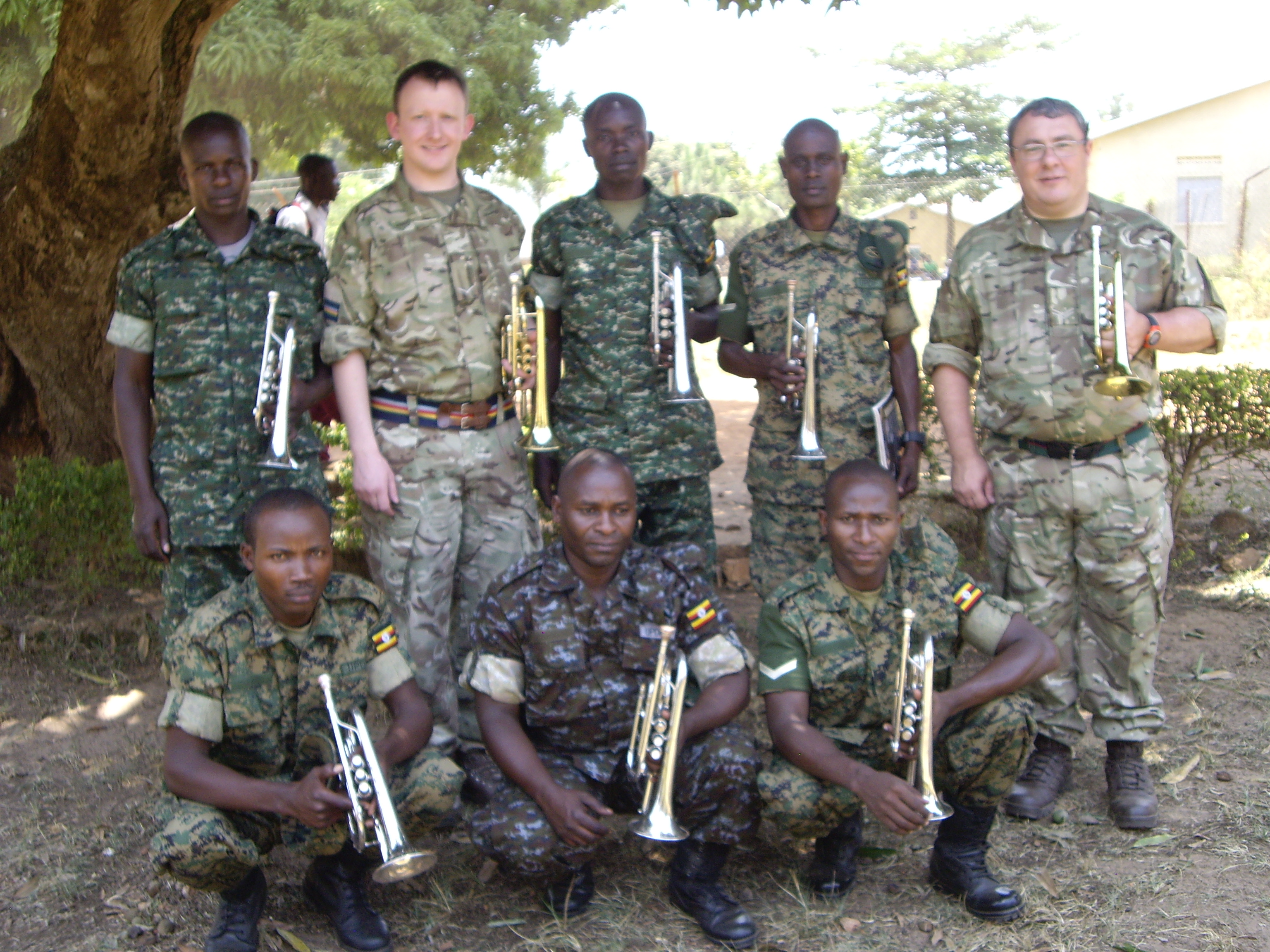
The trumpets and cornets of the UPDF Band with L/Cpl. John Pearson and Cpl. Andrew Jones

Our timetable was extremely tight and our aim was to prepare the Band for an inspection 6 days later from the British Army’s Defence Attaché to Uganda, Lt. Col. Nicholls, where we would demonstrate what we had been working on.

What the Ugandans lacked in knowledge and skills, they made up for by the bucket load in terms of enthusiasm and desire to learn, this was evident by their constantly practising through their breaks and continuing long after we had gone each day!  So, despite huge odds against success, the joint efforts of the Band and the STTT tutors saw the Band perform a piece called “Sunset” (significant to Military personnel and performed at the close of day), as well as the Ugandan and UK National Anthems to a large group of Senior Ugandan Officers, plus a suitably impressed Lt. Col. Nicholls, who was staggered at the achievements of the musicians, in such a short time-frame.

2015-03-05 13.52.10

Working on drill technique with the UPDF Band

Following our demonstration to our guests, the members of the UPDF Band were eager to know when we intended to return and even asked if we could extend our visit somehow. This was the ultimate compliment that they could have paid the CAMUS Team our efforts and one that we appreciated very much indeed.

IMGP4715

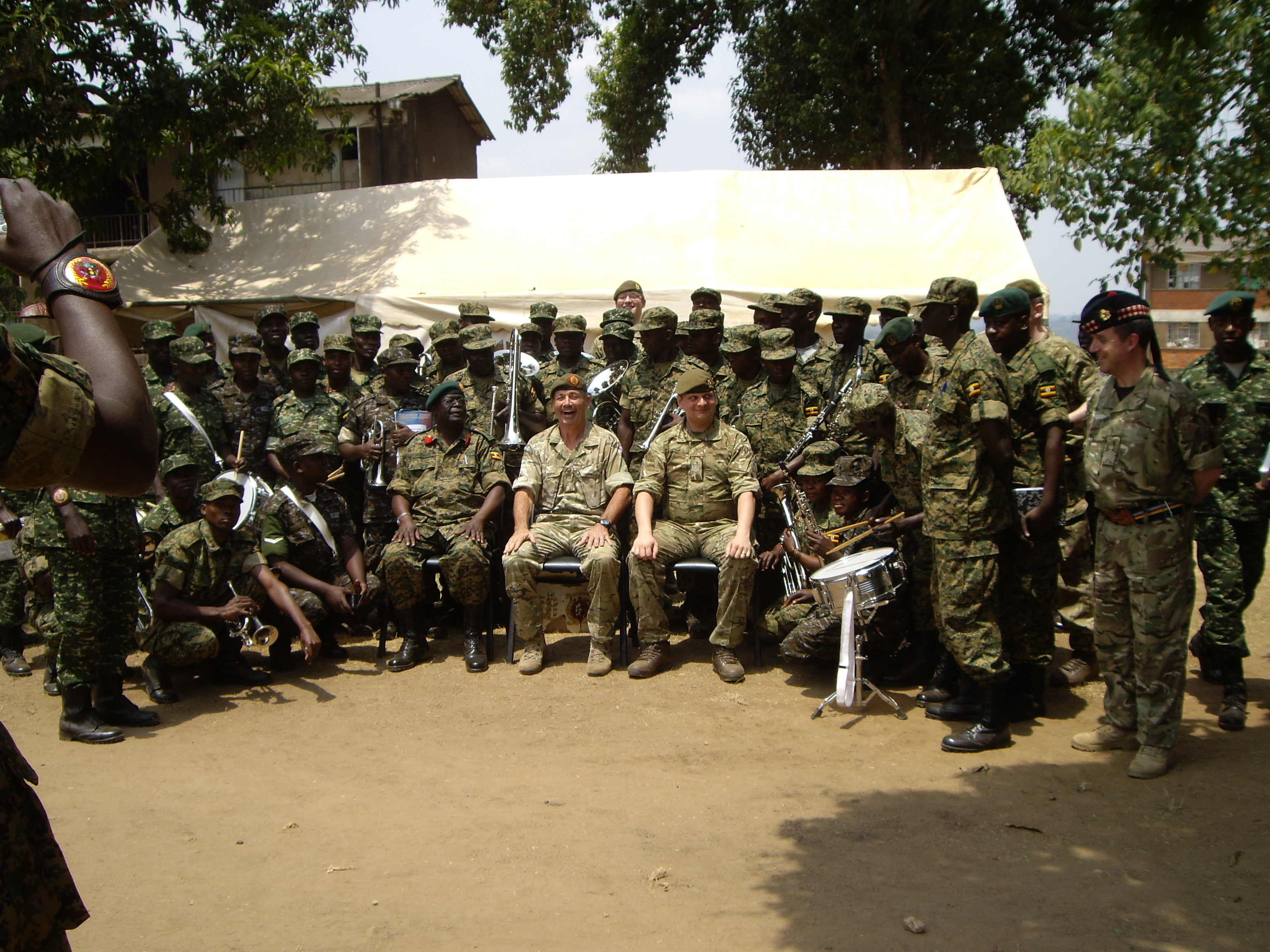
Lt. Col. Nicholls and W01 Burton with the UPDF Band members and CAMUS Team

The over-riding thought that all the members of the CAMUS Team brought away from our time in Bombo, was that with the right preparation, enthusiasm, drive and energy from all parties concerned, anything is achievable.

I very much hope that the legacy of our short time with the UPDF Band, will be that they are a stronger and more informed unit of musicians, who will go to bigger and better things over the coming months and years. One hopes we can revisit them in the not too distant future, to see and hear that progress and maybe help them develop even further.

IMGP4654

W01 Richard Burton and S/Sgt. John McQuat putting the UPDF Band through its paces

In my next blog about my trip to Uganda, I’ll be writing about the amazing Charity, Brass for Africa. Hope you’ll come back and read it!

New Horizons

It’s funny how you reach a point in your life (both personally and professionally), when you start looking for new challenges and opportunities, in order to bring a freshness and variety to a lifestyle that has perhaps, in one’s mind, become rather mundane, predictable and possibly unfulfilling.

I hit this point in 2006, when aged 39 – “Wait a minute” I hear you cry! “All makes sense now. It was the mid-life crisis!” – Moving on swiftly, I decided that I needed to “freshen things up” in my life. For the previous 12 years, I had been “living the dream” working as a freelance musician and enjoying the variety that goes with the job. I certainly wasn’t bored or unfulfilled, as I considered myself to be in a very privileged position of doing what I loved AND getting paid for it. However, I felt that I had reached my peak, in terms of achievements/ambitions and would be hard pressed to better them in the future.

At this point, I should point out that my CV wasn’t looking too shabby and I had visits to most of Europe, the USA, Canada, Australia and New Zealand under my belt, plus performance at the Grieghalle in Bergen, the Royal Albert Hall, Symphony Hall Birmingham and Brisbane City Hall, as well as having performed with the Royal Liverpool Philharmonic Orchestra, Royal Harpist Catrin Finch and Trumpet legend Maurice Murphy, to name but a few. So what was the problem? I guess, like most people, I craved not more perhaps, but something …….. “different”.

Then, in March of that year, whilst attending the Welsh Area Brass Band Championships in Swansea, a chance encounter with a brass band colleague who was working on the Recruitment stand for the Regimental Band of The Royal Welsh, led to a conversation about the Band and it’s activities. I had always been interested in all things Military and was aware of the Band and its activities, however, never in my wildest dreams had I given a second thought that I might even consider joining up or becoming a part-time soldier.

Well, fast-forward just short of 9 years and I am now a Corporal in that very Band, having visited Australia, Italy, Canada, Luxembourg and Germany. I have performed for Her Majesty the Queen, Princes Charles and William and appeared at Sydney Opera House, the Royal Nova Scotia International Tattoo and the Millennium Stadium for the Welsh International Rugby Internationals (including performing the “Last Post” live to 70,000+ fans and on Global Television), as well as performing alongside Katherine Jenkins, Only Men Aloud and the Band of the Welsh Guards.

IMG_4715

It would also be remiss of me, not to mention the huge honour and privilege of performing the Last Post at the Funerals of 4 serving soldiers killed in action in Iraq and Afghanistan, as well as a repatriation Service at RAF Brize Norton.

I write this, having returned yesterday, from a 10-day tour of Uganda, as part of a Corps of Army Music (CAMUS) Short Term Training Team that worked with the Ugandan Peoples’ Defence Force Band, as well as the youngsters from the Charity Brass for Africa. This was such a rewarding and humbling experience, that really hammered home the fact that there really were still new challenges and opportunities for me to explore back in 2006 and boy, how glad was I that I took that chance and ensured that “mundane, predictable and unfulfilling” were not part of my vocabulary in the next 9 years and beyond!

IMGP4699

For those of you with a curious streak and would like more information about the Regimental Band of The Royal Welsh, drop me a line and let’s see where the conversation goes from there. Who knows, this could be your “New Horizon” moment!