The unsung “Champions” on our doorstep

In an earlier blog, I wrote about exploring “new horizons” and doing something different, in order to “spice things up” in one’s career.

Since writing that, I have been very lucky to have been given yet another opportunity to push the boundaries, but this time it’s not a new experience, but one however that has challenged me (in every sense) to the very limit and given me a much deeper appreciation, of the standard of music-making that goes on around us, on a day-to-day basis, much of it unacknowledged and without suitable recognition.

My musical upbringing was in the brass band movement, learning to play the Cornet aged 7, with the Crwbin Silver Band. With just 2 pubs, 2 chapels and a church in my home village in the Gwendraeth Valley, there wasn’t much for a young person to do, so joining the local band seemed the obvious thing to do, especially as my Father, Uncle and Cousins were already playing in it.

scan0004

Where it all began – Crwbin Silver Band c.1974 (I’m the one sat in front of the bass drum)

I remember my first competition with them, was at the Brangwyn Hall, Swansea in 1976 on Edward Gregson’s “Voices of Youth”. Having performed in the 4th Section, I recall spending the rest of the day, not only sitting, gazing at the fantastic murals on the walls of this fantastic venue (some might disagree), but listening in awe to the bands in the Championship Section tackling Gilbert Vinter’s “Spectrum”. Names like Parc & Dare, Tredegar and Cory led by Ieuan Morgan, Bram Gay and John Childs.

These names were for me, the equivalent of Chelsea and Mourinho and Manchester United and Van Gaal for a young kid today. Superstars and demigods whose skills and talents were of a different planet to mine. The music too, was also of a “language” that I was totally unfamiliar with, yet there was something about “Pageantry”, “Variations for Brass Band” and “Contest Music”, that caught my ear and made me thirsty to hear more and more.

Little did I know at the time, that listening to these and future performances in that Hall over the coming years would shape and influence my dreams and ambitions for the future. I certainly never expected things to have panned out as they have now.

Fast forward approximately 40 years and I have had the great honour and pleasure of not only having played for Parc and Dare and Tredegar at the National Championships, the British Open and European Championships, but also conducted both bands in concerts and competitions, attempting in some small measure to follow in the footsteps of those icons who were my childhood heroes.

10382845_641288682622614_1098533009483515872_n

Parc and Dare Band – 2014

The scrapbook will this weekend be somewhat more complete however, as I take to the stage of the European Brass Band Championships in Freiburg, Germany, performing as a guest player with the Cory Band, where they will compete with bands from England, Norway, Belgium to name but a few, to win the coveted title.

The circumstances for being invited to play are extremely sad but that aside, I am extremely excited (yes, even aged 40 something I can still get animated about my music-making!) to be performing at one of the premier events in the brass band calendar.

Each band performs a test-piece (this year written by Rolf Rudin entitled “The God Particle”) on the Friday evening, then the following day return to play an own-choice work. The aggregate points awarded for each performance will then decide who is the victor. Having been a former Champion and the No.1 ranked brass band in the world for the past 8 or so years, it’s safe to say that Cory are in with a shout at least! Not that they are taking that as a God-given (sorry, no pun intended!) right to win the title. It will be down to good old-fashioned hard graft, blood, sweat and a few tears perhaps.

In the last few weeks, since trying to get to grips with “The God Particle” and the other work (I can’t tell you what it is, as it’s highly classified information!) I have been reminded of the amazing standards and levels of commitment that our nation’s brass bands are capable of. Listening to them perform is one thing, however, when you’re at the coal-face and getting stuck in as a player, one instantly can appreciate the intensity of concentration and sheer effort given to every single note produced during those rehearsals. Not that the conductor doesn’t earn his corn either mind, as I well know. Philip Harper, Cory’s Musical Director, has worked tirelessly in his preparation, meticulously dissecting the scores to get the very best out of his players.

With still a few nights’ rehearsals to go, I know the band will move up another few gears in terms of their performance, which given how well they are playing already, is scary to think what levels it could potentially achieve. The purpose though of my writing, is to highlight that for all it’s successes and the incredible standards achieved, the brass band movement never really gets the plaudits and acknowledgment it so thoroughly deserves, either in the press and media or often from its local community.

Cory_Smallish

For Wales alone to have 2 bands (Cory and Tredegar), in the top 3 world rankings must count for something surely? However, a dog performing tricks on a prime time TV “talent” show will get more air time and social media publicity than any of our brass bands ever will sadly.

In the meantime, know that regardless of their status in the rankings, the brass band on your door-step may not all be world-beaters, but they work their socks off, contributing to the local community when needed for Carols at Christmas, playing at a Charity Concert when raising much-needed money for the local hospice or children’s hospital or providing music for the annual Remembrance Parade. Not to forget also giving great pleasure to many people along the way. As if that wasn’t enough, they’ll also give you and your kids the opportunity of learning to play an instrument, (usually for no more than a couple of quid a week) AND they’ll probably lend you an instrument free of charge!

Let’s hope that Chelsea win the Premier League this week and that come next Monday, there may be a few spare column inches on the front page of the paper to hopefully announce that a certain Welsh brass band has become Champions of Europe!

Don’t shoot the messenger – the poor old Trumpet player always gets it “in the neck”!

Today’s blog gives a brief insight to the curious use of the Trumpet, both in conveying important messages to others and how it’s use has become iconic and symbolic for one particular European City.

In 2008, I was fortunate enough to be the Musical Director for the Greater Gwent Youth Brass Band’s Tour of  Poland. This was a pretty ambitious project, involving not only the Brass Band, but also the County Symphony Orchestra and a Chamber Choir. This amounted to a travelling entourage of around 150 students and staff!

The Ensembles performed at a variety of locations in Poland including the Church in Zakopane, nestled in the beautiful Tatras mountain region, which was built as a gesture of thanks to God, for saving the life of Pope John Paul II after the assassination attempt in 1981.The Shrine of Our Lady of Fatima in Zakopane OLYMPUS DIGITAL CAMERA

In addition, our Tour took us to the beautiful City of Kraków and the amazing Church of St. Catherine’s, with its high ceilings and ornate decor, especially the breath-taking Altar and Rood Screen. OLYMPUS DIGITAL CAMERA

St. Catherine’s Church, Kraków

Whilst in Kraków one day, I was walking across the main square in the City, when I saw a group of tourists gathered and looking up in the air at something. Being of a somewhat nosey, sorry, curious disposition I also stopped to see what was causing so much interest. Everyone seemed to be looking at a Church Tower (which I later learned was Saint Mary’s Church. Nothing much seemed to be happening and people were regularly checking their watches, so having given up hope of anything exciting happening, I was about to walk off, when one of the group shouted out and pointed at one of the windows in the Tower.

In the Tower window high above, stood a figure who looked down at the ever-increasing throng and gave a quick wave. What happened next was totally unexpected however. He suddenly went out of sight only for a trumpet bell to suddenly appear out of the window and the sounds of a very lyrical but simple melody were heard wafting over the square. It was quite mesmerizing and continued for nearly a minute, only to stop abruptly mid-phrase! Most of the curious audience (including myself) were highly baffled by all this, but before we could even question what we had just witnessed, the whole process was repeated but this time, from another window from the Tower. In fact, this occurred on four separate occasions, in quick succession, each time with the melody ending abruptly at the same musical point (or non-musical place if you were looking for a logical ending to the tune, as I was!).

Had I done my homework prior to going to Kraków however, or consulted a tourist guide-book, I would have learned that this tradition has been in existence for centuries, with a variety of stories, legends and myths regarding it’s origin and meaning.

First of all though, let’s deal with hard facts. The melody or “call” is known as Hejnał Mariacki (pronounced “Hey-now Mahr-yahts-kee”), meaning “St. Mary’s Dawn”; also called the Kraków Anthem). This is a traditional, five-note Polish melody which is played every hour on the hour, 365 days a year. Such is it’s importance in Polish culture, the mid-day performance is broadcast via radio to all of Poland and the world.  In fact, 71 years ago this week, the  Hejnał was played by a bugler from the Polish Army to announce the Polish victory in the Battle of Monte Cassino on 18 May 1944. It is unclear who wrote it, but Civic records actually refer to it officially as far back as 1392 and was originally played by the town guard to warn of fires or signal the end of a guard watch. Since the 19th century however, the Hejnał has been performed by active members of the fire brigade, who currently provide at least four different buglers serving in shifts at the tower. Despite its apparent monotony, this duty is carried out with great pride and precision by each trumpeter and is regarded as a hugely prestigious task, with some players having given 30+ years continuous service performing it.

Now for the conjecture bit. I will let you do your own research and decide which you believe is the most credible version, however some state the tune is performed in four different directions in honour of the King of Poland, the Mayor and the Bishop, the citizens of Kraków and finally the peasants/visitors Kraków. My favourite version however, is that during the first Mongol invasion of Poland (yes they got around a bit those guys!) of 1241, troops led by one of Genghis Khan’s Generals – General Subutai – were attacking the City and a sentry on a tower of St Mary’s Church sounded the alarm by playing the Hejnał. Thanks to the sentry’s vigilance, the gates were closed before the invaders were able to ambush the city. The poor trumpeter, however, was shot in the throat and did not complete the anthem, hence the reason for the abrupt ending to each performance!

A more recent explanation for the sudden ending may stem from the sudden death of the performer, whilst on duty at midnight on 7 July 1901. Whichever story you might wish to believe, the Trumpet has shown its versatility once again, in not only bringing musical pleasure to so many, but also in being a method of communication, an early warning system and a very potent tourist attraction. Who says live music is for the elite? Hejnał mariacki played by a trumpeter from the tower of St. Mary’s Church (Kościół Mariacki) in Kraków.

P.S. – When the postman delivers the Gas bill next time, don’t shoot the messenger, he’s only doing his job!

St. Mary’s Church in Kraków. The Hejnał is performed 4 times on the hour every hour from the Tower on the left. HELLOMOTO

If you require a Bugler or Trumpeter for an event, please visit Andrew Jones (Music for You)

New Horizons

New Horizons/ Brass & Percussion players looking for new challenges, read on

welshtrumpeter's avatarMusic for You

It’s funny how you reach a point in your life (both personally and professionally), when you start looking for new challenges and opportunities, in order to bring a freshness and variety to a lifestyle that has perhaps, in one’s mind, become rather mundane, predictable and possibly unfulfilling.

I hit this point in 2006, when aged 39 – “Wait a minute” I hear you cry! “All makes sense now. It was the mid-life crisis!” – Moving on swiftly, I decided that I needed to “freshen things up” in my life. For the previous 12 years, I had been “living the dream” working as a freelance musician and enjoying the variety that goes with the job. I certainly wasn’t bored or unfulfilled, as I considered myself to be in a very privileged position of doing what I loved AND getting paid for it. However, I felt that I had reached my peak…

View original post 482 more words

Corps of Army Music Tour to Uganda – March 2015 (Part 1)

I have just returned from a 10-day Short Term Training Team (STTT) Tour of Uganda, with the Corps of Army Music (CAMUS) and would like to share my experiences with you.

Following a day’s briefing at the Royal Military School of Music at Kneller Hall, the 7 man Team (consisting of musicians from the Bands The Prince of Wales’s Division, The King’s Division, Royal Welsh and The Royal Regiment of Scotland) flew out from Heathrow to the Capital, Kampala, where we were to be based for the duration of our stay.

The primary aim of the Tour was to provide support and training to the Ugandan Peoples’ Defence Force (UPDF) Band, assisting them in a wide range of disciplines, including music theory, performance technique as well as drill and deportment.

The UPDF Band is based in Bombo, which is an hour’s drive outside Kampala. Although it involved an early start each day, the journeys gave us a flavour of what the real Uganda looks like and was an eye-opener in terms of the local slant on driving “skills”. Thankfully my knuckles have returned to normal and aren’t white any more!!

Despite a pre-visit having taken place prior to our deployment, the UPDF Band were somewhat disorganised when we arrived on the first day, but some firm (but polite diplomacy) and flexibility from our lead Officer (Warrant Officer Class 1) Richard Burton, who is Bandmaster of the King’s Division Band, ensured that we got off to a good solid start that day.

The facilities at Bombo were basic to say the least, but the Band seemed reasonably well equipped with a variety of instruments of different quality. What was apparent however was that the vast number of the 42 musicians we were working with, had received little or no formal musical training, due to a lack of expertise and training resources, such as specialist tutors, sheet music and theory books.

IMGP4699

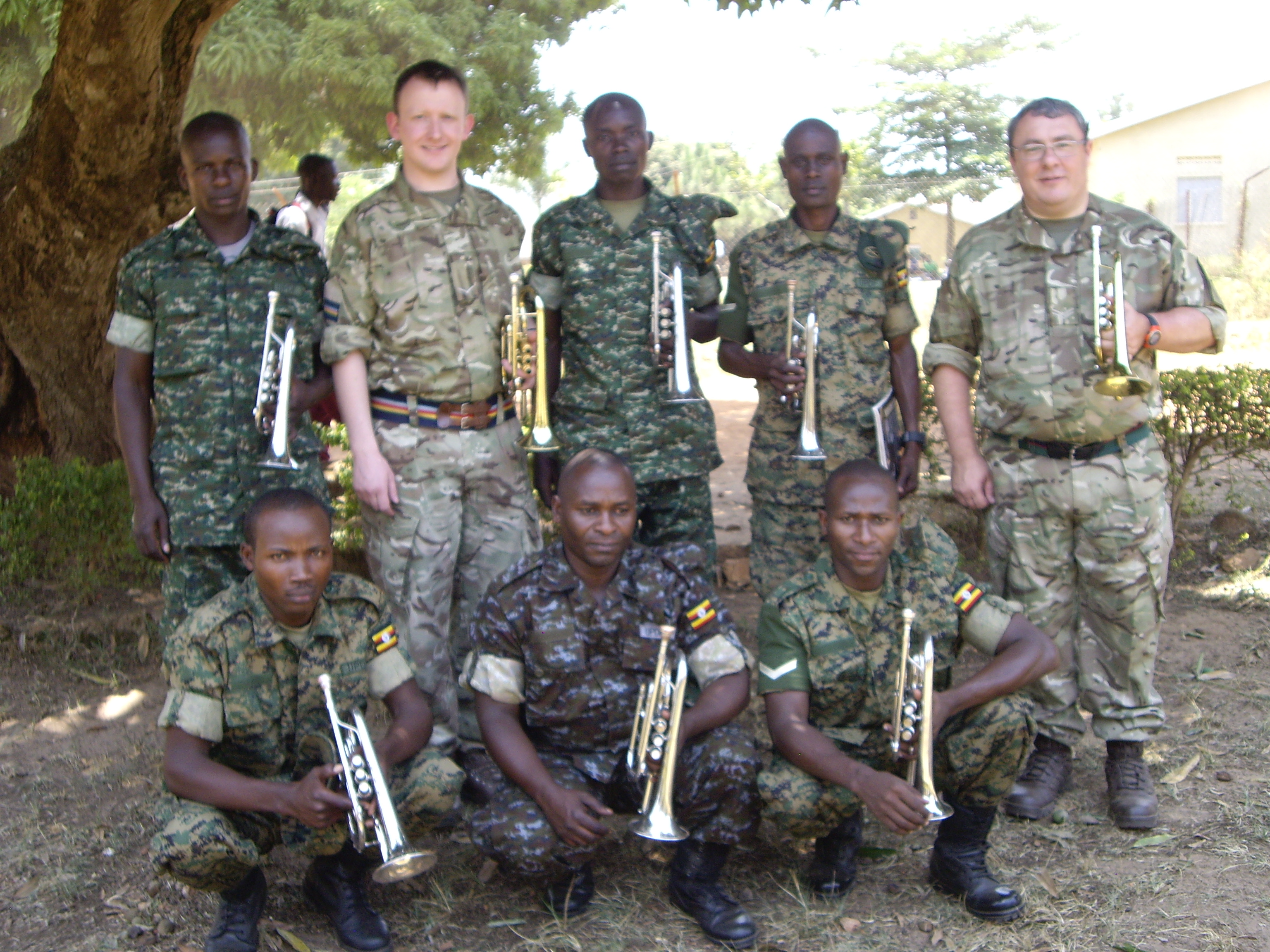
The trumpets and cornets of the UPDF Band with L/Cpl. John Pearson and Cpl. Andrew Jones

Our timetable was extremely tight and our aim was to prepare the Band for an inspection 6 days later from the British Army’s Defence Attaché to Uganda, Lt. Col. Nicholls, where we would demonstrate what we had been working on.

What the Ugandans lacked in knowledge and skills, they made up for by the bucket load in terms of enthusiasm and desire to learn, this was evident by their constantly practising through their breaks and continuing long after we had gone each day!  So, despite huge odds against success, the joint efforts of the Band and the STTT tutors saw the Band perform a piece called “Sunset” (significant to Military personnel and performed at the close of day), as well as the Ugandan and UK National Anthems to a large group of Senior Ugandan Officers, plus a suitably impressed Lt. Col. Nicholls, who was staggered at the achievements of the musicians, in such a short time-frame.

2015-03-05 13.52.10

Working on drill technique with the UPDF Band

Following our demonstration to our guests, the members of the UPDF Band were eager to know when we intended to return and even asked if we could extend our visit somehow. This was the ultimate compliment that they could have paid the CAMUS Team our efforts and one that we appreciated very much indeed.

IMGP4715

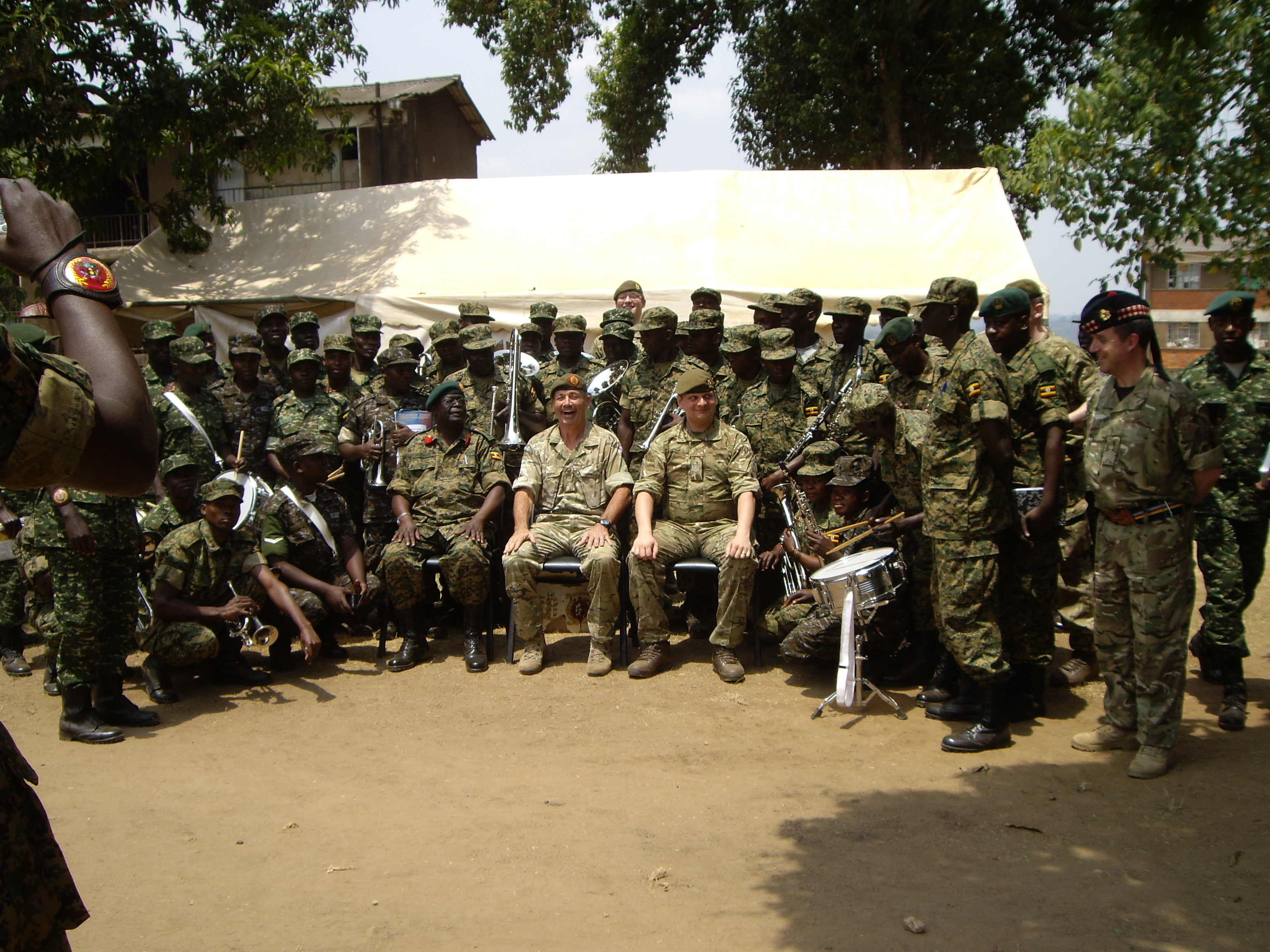
Lt. Col. Nicholls and W01 Burton with the UPDF Band members and CAMUS Team

The over-riding thought that all the members of the CAMUS Team brought away from our time in Bombo, was that with the right preparation, enthusiasm, drive and energy from all parties concerned, anything is achievable.

I very much hope that the legacy of our short time with the UPDF Band, will be that they are a stronger and more informed unit of musicians, who will go to bigger and better things over the coming months and years. One hopes we can revisit them in the not too distant future, to see and hear that progress and maybe help them develop even further.

IMGP4654

W01 Richard Burton and S/Sgt. John McQuat putting the UPDF Band through its paces

In my next blog about my trip to Uganda, I’ll be writing about the amazing Charity, Brass for Africa. Hope you’ll come back and read it!

New Horizons

It’s funny how you reach a point in your life (both personally and professionally), when you start looking for new challenges and opportunities, in order to bring a freshness and variety to a lifestyle that has perhaps, in one’s mind, become rather mundane, predictable and possibly unfulfilling.

I hit this point in 2006, when aged 39 – “Wait a minute” I hear you cry! “All makes sense now. It was the mid-life crisis!” – Moving on swiftly, I decided that I needed to “freshen things up” in my life. For the previous 12 years, I had been “living the dream” working as a freelance musician and enjoying the variety that goes with the job. I certainly wasn’t bored or unfulfilled, as I considered myself to be in a very privileged position of doing what I loved AND getting paid for it. However, I felt that I had reached my peak, in terms of achievements/ambitions and would be hard pressed to better them in the future.

At this point, I should point out that my CV wasn’t looking too shabby and I had visits to most of Europe, the USA, Canada, Australia and New Zealand under my belt, plus performance at the Grieghalle in Bergen, the Royal Albert Hall, Symphony Hall Birmingham and Brisbane City Hall, as well as having performed with the Royal Liverpool Philharmonic Orchestra, Royal Harpist Catrin Finch and Trumpet legend Maurice Murphy, to name but a few. So what was the problem? I guess, like most people, I craved not more perhaps, but something …….. “different”.

Then, in March of that year, whilst attending the Welsh Area Brass Band Championships in Swansea, a chance encounter with a brass band colleague who was working on the Recruitment stand for the Regimental Band of The Royal Welsh, led to a conversation about the Band and it’s activities. I had always been interested in all things Military and was aware of the Band and its activities, however, never in my wildest dreams had I given a second thought that I might even consider joining up or becoming a part-time soldier.

Well, fast-forward just short of 9 years and I am now a Corporal in that very Band, having visited Australia, Italy, Canada, Luxembourg and Germany. I have performed for Her Majesty the Queen, Princes Charles and William and appeared at Sydney Opera House, the Royal Nova Scotia International Tattoo and the Millennium Stadium for the Welsh International Rugby Internationals (including performing the “Last Post” live to 70,000+ fans and on Global Television), as well as performing alongside Katherine Jenkins, Only Men Aloud and the Band of the Welsh Guards.

IMG_4715

It would also be remiss of me, not to mention the huge honour and privilege of performing the Last Post at the Funerals of 4 serving soldiers killed in action in Iraq and Afghanistan, as well as a repatriation Service at RAF Brize Norton.

I write this, having returned yesterday, from a 10-day tour of Uganda, as part of a Corps of Army Music (CAMUS) Short Term Training Team that worked with the Ugandan Peoples’ Defence Force Band, as well as the youngsters from the Charity Brass for Africa. This was such a rewarding and humbling experience, that really hammered home the fact that there really were still new challenges and opportunities for me to explore back in 2006 and boy, how glad was I that I took that chance and ensured that “mundane, predictable and unfulfilling” were not part of my vocabulary in the next 9 years and beyond!

IMGP4699

For those of you with a curious streak and would like more information about the Regimental Band of The Royal Welsh, drop me a line and let’s see where the conversation goes from there. Who knows, this could be your “New Horizon” moment!

Make someone’s day, by writing them a testimonial

I’ve just got in from a meeting and started ploughing my way through the myriad of e-mails offering me every Christmas bargain going, the scam asking me to deposit all my life-savings in some off-shore Bank in Liberia and the obligatory mail, offering me various medical products that will supposedly endear me to my Wife even more than my already successful Marriage could ever imagine!

In amongst all this detritus however, was an e-mail from a Funeral Director that I had recently worked with, where I performed The “Last Post” for an ex-Comrade’s Funeral Service.

It basically went as follows:

“Good afternoon Andrew,

I felt that I should write to you regarding the funeral of Mr. M.  The respect you gave to this service was first class. The family wanted to give their father a day he would be proud of, which included the Royal British Legion and standard bearers, the Union Flag on the coffin and as they said, the icing on the cake you.

He was very proud of his country and his war record and as the family said you brought everything together. They said to pass on their heart-felt thanks to you.

The older men at the service all said the same thing ‘note perfect’ – the only place you hear the Last Post played like that is at the Cenotaph.

You have given the family a wonderful memory which will last a life time.

On behalf of myself and the family and all the staff who had the pleasure to hear you play, I thank you so very much and can’t wait to work with you again.”

This simple gesture took only a matter of minutes to do, but has left me glowing with pride and satisfaction, knowing that I gave my best for that old Soldier, his family and all the other people present and that my services were noted, valued and hopefully will be remembered for future opportunities with that Funeral Director (and others by recommendation).

If you have received good service from someone today, write a short testimonial and put a smile on their face. It will be the best Christmas gift you can give them!

For more details about Andrew Jones please visit www.andrewjonesmusic.com

Photography by Paul Fears

 Christmas-Trumpet

Audience etiquette. Are Musicians being precious, or is this a deeper issue?

Those who know me well, will tell you that I am a very patient and tolerant person. I “go with the flow” on most things in everyday life, but there is one thing I can’t stand and will not tolerate, and that’s rudeness and bad manners.

Each one of us will have a different definition of rudeness, however my attention was drawn to the media reports this week, following the Wales v Australia Rugby International, played at the Millennium Stadium in Cardiff. (I’ll just quickly squeeze in here, that I was in the Regimental Band of The Royal Welsh, that played the Anthems prior to the kick-off!). There was much made about the pockets of bad-mannered fans who were booing the Australians when kicking for goal, despite repeated requests over the public-address system for quiet. This usually takes place in complete silence, out of respect to the kicker! Yes, 60,000+ people, even if the majority want him to miss!

With tickets now being made available to a wider non-rugby based audience – previously the vast majority were sold to rugby clubs – there is now a cross-section of “supporters” attending matches, many of whom now just go for the atmosphere and the “craic” and have no real understanding of the niceties of the game itself, nor the way a fan is expected to conduct themselves throughout the game.

Then, last night, a friend of mine (who is a member of a world-renowned orchestra) posted on social media, that a number of the audience at a performance he was participating in, talked all the way through the entr’acte to an Opera. Now some of you are thinking, “What’s the big deal, the performance doesn’t really start until the curtain goes up and the singers start?” Others, like me are thinking, “How rude and how disrespectful!”

Gethin Liddington is one of the finest Jazz Trumpeters on the UK circuit nowadays – and one of the most placid guys you will ever meet – yet he mentioned to me that he regularly has to contend with people talking through his gigs, often just feet away from him, making it very difficult to concentrate and to enjoy the gig. Should a performer have to get embroiled in a dialogue with a member of the audience and politely ask them to be quiet (because they didn’t know any better), or are they just being downright rude and ignorant?

I have sat in the audience, where someone sat in front of me talked all the way through a Concert, up until their “little precious” took to the stage. Suddenly the ground-rules took a seismic shift and woe-betide anyone who dared to cough or rustle their programme during Hermione’s special solo! That person was just rude and ignorant in my book. Oh, once Hermione finished her slot, said person left the Concert before it finished, upsetting Tabitha’s parents during her special solo – but that didn’t matter of course!

Music has sadly been consigned by many, to be something that goes on in the background of our lives. During Sports results on TV, whilst we’re in the lift or shopping in the Mall, or on hold on the phone waiting to sort out our gas bill query. To talk through any music is the norm now it seems.  So as venues, ensembles and musicians constantly strive to attract new audiences, is it necessary for us to “gently” advise our newer patrons, that a certain “etiquette” is expected of them? Then they won’t inadvertently upset performers and audience alike. As for the established audience members, who continue to talk and leave mid-performance, perhaps they just need a large dose of manners?

PorthcawlPavilionBigBandPictures016

Andrew Jones (far left) and Gethin Liddington (2nd from left) in action with the Phil Dando Big Band

For more details about Andrew Jones and Music for You, please visit the following website.

Money, Get Away, Get a Good Job With More Pay and Your O.K.

PhillCourtMusic's avatarPhill Court Music

I picked up the bass to initially impress a girl. Fast forward many years and I have a bass guitar strap wrapped around my neck and no girl. I never envisioned becoming a professional musician, not at least getting paid! I was having fun running around pubs, clubs and any venue that would have our little group. Our payment was either £20 behind the bar (mines a guiness please) or a free meal voucher. Now that’s all well and good, but then it hit me. During a charity concert I was thinking. The bar staff are getting paid, the stage crew are getting paid, the security, the various stalls. They were all getting paid apart from us! I thought it was wrong then and I think it is wrong now. As a musician I am providing a service to the person/persons who booked me. I expect to get paid. Why shouldn’t…

View original post 341 more words

Happy Birthday to a Pioneer

When talking about Pioneers who have been notable in developing and advancing a particular movement or industry, one thinks of names such as  Louis Pasteur, the Wright Brothers and Thomas Edison. In the world of music, names such as Bach (Fugue) and Haydn (Symphony) spring to mind, when discussing composition, but there are other figure-heads, or “movers and shakers” as we now like to call them, that are maybe not as well-known, but no less influential in their respective fields. On this day in 1935, saw the birth of trumpeter, conductor, composer and arranger Elgar Howarth. Howarth was brought up in a traditional brass band background (his Father was a conductor) and went on to study music at Manchester University and the Royal Manchester College of Music, alongside the likes of Harrison Birtwistle and Peter Maxwell Davies. This collective would be later known as  New Music Manchester, promoting the composition and performance of new music. Howarth was a key figure in bringing brass band and symphonic (orchestral) brass ensemble repertoire in to the 20th Century and to a whole new audience. This audience however, included both performer and listener alike. Through his pioneering work with the Grimethorpe Colliery Band and the Philip Jones Brass Ensemble, he succeeded in composing and arranging repertoire that brought these genres in front a whole new audience, making massive advancements in terms of instrumental combinations and blends of sounds. Within the brass band movement, Concerts and Entertainment Contests would now never be the same, following Grimethorpe’s ground-breaking performance in 1972, at the Granada Band of the Year Competition, where Howarth compiled a programme that would completely revolutionise how conductors would approach programming and presentation from therein. As for the PJBE, along with Philip Jones himself, the “standard” Brass Quintet format was born, consisting of 2 Trumpets, a French, Trombone and Tuba, plus the 10-piece Ensemble of 4 Trumpets, French Horn, 4 Trombones and Tuba. Repertoire using larger forces were to follow, making brass chamber music a vibrant and exciting genre, which would stimulate new works from composers such as Malcolm Arnold, Ray Premru, Stephen Dogson and many more. Many of his compositions were initially shunned by the brass band movement, being regarded as too avant-garde, but in time, works such as “Fireworks” and “In Memoriam RK” have been accepted in to the hearts of players and listeners alike. He also appeared under the pseudonym of W. Hogarth Lear, showing a much lighter and humorous side to his personality. Happy Birthday Mr. Howarth and thank you for your pioneering work and legacy! 220px-Elgar_Howarth%2C_Halesworth%2C_Suffolk%2C_December_2012

Why do musicians always need to practice?

I am one of those lucky people who is extremely fortunate to be living the dream and working in a job, which I enjoy immensely, hopefully bring pleasure to many, giving opportunities to travel the world (Hamburg, Germany this week with the Regimental Band of The Royal Welsh!), meet lots of interesting people and see some wonderful sights and ultimately get paid for the privilege.

Those are the perks. The downside features are the long, unsociable hours, particularly working evenings and weekends, the endless hours travelling to and from jobs and the volatility of work “feast or famine”. One minute not knowing what day it is and where you are meant to be next, followed by “Diary drought”, not knowing where the next job is going to come from. Despite all that, I know that there are many other trades and professions who share these issues and have much greater hardships to endure, so I’ll stop moaning. I wouldn’t change a thing, as I know I am extremely blessed to be doing what I do.

You would think though, that having now played the Trumpet and Cornet for just over 40 years (gulp!), that the need to practice was long gone and one could just get on with it, until finally deciding to “hang up one’s mouthpiece”. Alas, no!

“He’s not practicing again?” is the usual comment when someone pops round or rings the house, as the obligatory scales, lip-flexibility and technical exercises are rolled out, with religious necessity. Why? Well, put simply, being a brass player is just like being an athlete. Ok so we haven’t got the physique of Usain Bolt or George North (I wish!), but one must not only maintain and strive to improve standards, but ensure that lips muscles are kept strong and flexible to ensure good stamina and accuracy.

Co-ordination skills (fingers and tongue) and lung capacity when not breathing/blowing so intensely also go out of the window after any significant time off.

“So what is a significant period?” I hear you ask.

For me, I work on the old saying “Miss a day and you know about it. Miss 2 days and your friends know about it. Miss 3 days and every bugger knows about it!”. Sad but true I’m afraid. everything goes out of the window if I go more than a few days without putting the “hooter on my chops” for at least 20-30 minutes each day. I do have friends and colleagues however, who I know can go weeks without blowing a note and get away with it, with no apparent lack of quality or consistency. I hate them all for their good fortune!!!

Apart from athletes, how many other professions require that level of application I wonder? Do carpenters go down the shed every day to do a dovetail joint, or a chef pop in to the kitchen to work on a Beef Wellington ?

In the meantime, I will continue to count my lucky stars that I’m in a profession that I’m passionate about and hope that my “necessary” daily practise, allows me to stay in that role for many, many years to come.

For more information about Music for You, please visit my Web-site

Needs must! Martini practise session - "Any time, any place, anywhere"

Needs must! Martini practise session – “Any time, any place, anywhere”